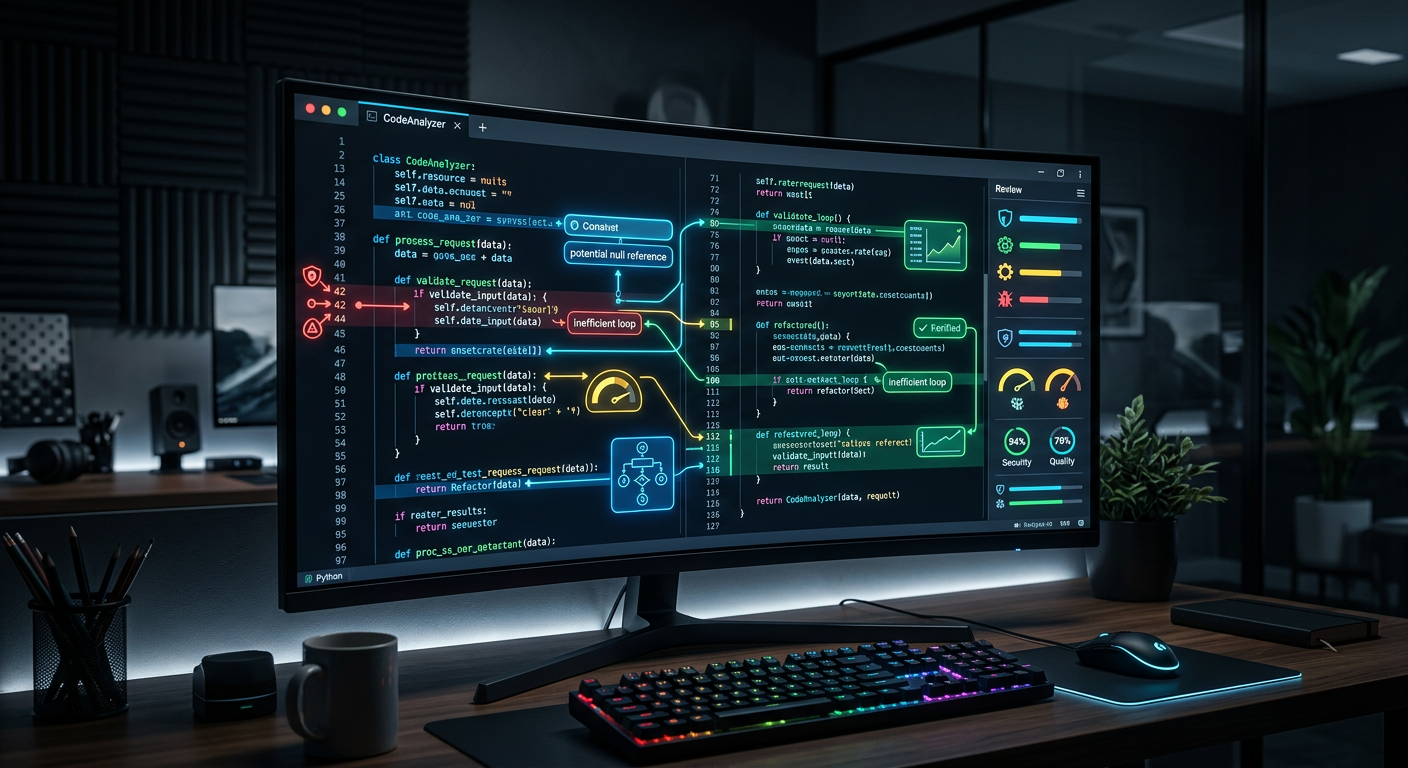
Anthropic launched a new Code Review feature for Claude Code on Monday, March 9, 2026, adding automated pull request analysis to its developer-focused AI tool. The feature arrives at a moment when AI-generated code is flowing into software projects at unprecedented volume, creating a growing need for tools that can verify output quality before it reaches production. Code Review is rolling out first to Claude for Teams and Claude for Enterprise customers in research preview.
What Was Announced
The Code Review tool integrates directly with GitHub, allowing it to automatically analyze pull requests and leave inline comments that flag potential bugs, logic errors, and suggested improvements. The system is designed to function as a continuous reviewer in developer workflows, operating between the moment a PR is opened and when a human reviewer picks it up. For teams generating significant volumes of AI-assisted code, the tool is positioned as a way to catch issues early rather than relying solely on human review capacity.
Anthropic is launching Code Review in research preview, which means the feature will evolve based on real-world feedback before reaching general availability. The initial rollout is limited to Claude for Teams and Enterprise customers, consistent with the company practice of testing professional-grade tools with users who can provide structured feedback on enterprise use cases.
The launch comes at a significant moment for Anthropic as a business. The company reported that Claude Code run-rate revenue has surpassed .5 billion since the product launched, and enterprise subscriptions have quadrupled since the start of 2026. Code Review represents an attempt to deepen the value proposition for teams already invested in the Claude Code ecosystem.
Technical Details
Code Review operates through GitHub integration, analyzing pull request diffs in context and generating line-level comments. The system leverages Claude understanding of code semantics to go beyond simple pattern matching, identifying issues that require reasoning about intended behavior rather than just syntax or style. This includes flagging potential off-by-one errors, incorrect conditional logic, missing edge cases, and functions whose implementations do not match their documentation.
The review runs automatically when a pull request is opened or updated, without requiring a developer to explicitly invoke it. Comments appear in the standard GitHub PR review interface, meaning teams do not need to change their existing code review tooling or workflow to incorporate Claude feedback. The integration is designed to complement rather than replace human review, providing a first pass that surfaces issues before a teammate invests time in reading the diff.
The research preview designation signals that Anthropic is actively collecting data on false positive rates, missed issues, and the quality of suggested fixes. Code review is a domain where low precision — too many irrelevant comments — can quickly erode developer trust in an automated tool, making calibration during the preview phase critical to long-term adoption.
Industry Impact and Reactions
The Code Review launch positions Anthropic more squarely in competition with a growing set of tools aimed at the AI-generated code quality problem. GitHub itself has been expanding Copilot review capabilities, and tools from companies including CodeRabbit and others have built businesses specifically around automated PR analysis. Anthropic advantage is the depth of context that Claude can maintain within a codebase, as well as the tight integration with Claude Code that allows the review tool to draw on understanding established across a developer existing sessions.
The broader challenge that Code Review addresses is one of the defining software engineering problems of 2026. As AI coding assistants become standard in development workflows, the volume of code being written has increased substantially, but review capacity has not scaled at the same rate. Automated review tools are increasingly viewed not as a convenience but as an essential quality gate for teams operating at speed.
Anthropic report of quadrupled enterprise subscriptions and .5 billion in Claude Code run-rate revenue provides important context for understanding why Code Review matters strategically. Enterprise customers who deeply embed Claude Code into their development workflows are significantly harder to displace, and adding PR-level code review further entangles the tool with the software delivery pipeline.
What Comes Next
The research preview phase will likely run for several weeks to months as Anthropic gathers feedback on review quality, false positive rates, and integration reliability. General availability timing has not been announced. The company is expected to expand the feature to additional repository hosting platforms beyond GitHub, though no specific integrations have been announced.
Future iterations may incorporate deeper codebase context, allowing the reviewer to flag issues that only become apparent when a change is considered alongside other recent modifications or against the broader system architecture. The current PR-diff focused approach is a practical starting point; more sophisticated analysis is a natural evolution for subsequent releases.
Conclusion
Anthropic Code Review for Claude Code is a well-timed product that addresses one of the most pressing practical challenges created by the rise of AI-assisted development. By integrating directly with GitHub and automating the first pass of pull request review, Anthropic is positioning Claude Code as an end-to-end development companion rather than just a code generation tool — and giving enterprise customers another reason to keep Claude at the center of their software workflows.
Stay updated on the latest AI news at Evolve Digital.
Leave a Reply