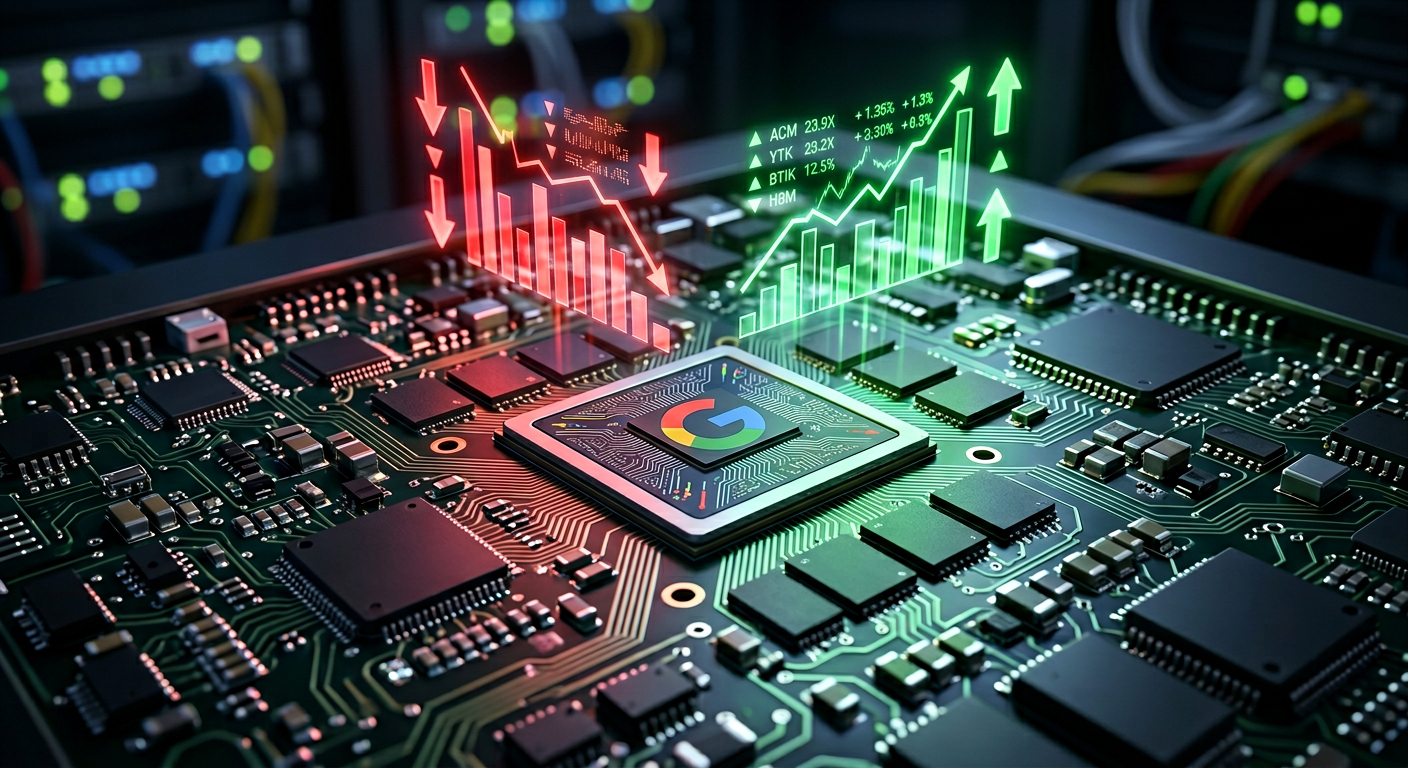
A new artificial intelligence breakthrough announced by Google in late March 2026 has sent shockwaves through the semiconductor market, exposing a meaningful divide between memory chip categories that analysts say reflects a structural shift in how advanced AI systems consume hardware resources. The development triggered a two-day selloff in select memory chip stocks while leaving others unaffected — a split that has become a focal point for investors trying to understand which parts of the AI hardware supply chain remain essential as the underlying technology evolves.
What Was Announced
Google disclosed an AI advance that, according to Bloomberg reporting from March 27, 2026, reduces the system’s reliance on certain categories of memory chip technology during inference workloads. The specific technical details of the breakthrough were not fully disclosed by Google, but the market reaction was immediate: shares of companies with heavy exposure to the affected memory segment declined over two trading sessions, while manufacturers of storage and memory types not impacted by the development saw more modest movement.
The announcement is part of a broader pattern of Google research disclosures that have increasingly emphasized efficiency gains alongside raw capability improvements. Google’s AI infrastructure teams, including those working on custom silicon under the Tensor Processing Unit (TPU) program, have been pursuing architectural approaches that reduce memory bandwidth requirements as a path toward more cost-effective inference at scale.
Google did not characterize the announcement as a commercial product launch, but rather as a research result with near-term implications for how the company designs and configures its AI data centers. That framing has not prevented the market from reading it as a signal with significant supply chain consequences.
Technical Details
The divide in memory chip stocks reflects a meaningful technical distinction. High-bandwidth memory (HBM) — the type of stacked DRAM that sits directly adjacent to AI accelerators and feeds them data during training and inference — has been one of the defining bottlenecks and cost drivers in large language model deployment. If Google’s breakthrough reduces or restructures HBM demand, it has direct implications for companies like SK Hynix, Micron, and Samsung, which have invested billions in HBM production capacity anticipating sustained AI-driven demand growth.
Other memory and storage categories — including NAND flash and conventional DRAM used for model weights storage and serving infrastructure — were less affected by the announcement, because these components serve different roles in the AI stack that are not directly addressed by the efficiency improvements Google described. This is the source of the divide: the breakthrough appears targeted at the high-bandwidth, high-cost memory layer rather than storage more broadly.
Industry analysts note that efficiency-driven memory demand reduction is a known risk to the AI chip supply chain, but one that had been considered a longer-horizon concern. A credible Google disclosure accelerating that timeline has caused institutional investors to reprice their assumptions about how quickly efficiency gains will begin to flatten memory demand curves at the frontier of AI deployment.
Industry Impact and Reactions
The market reaction to the Google announcement underscored just how tightly AI hardware investment theses are tied to assumptions about memory consumption per AI operation. The conventional model — more capable AI equals more memory demand — has driven enormous capital allocation into HBM manufacturing. A research result that challenges that linearity is inherently disruptive to those investment cases, even if commercialization is months or years away.
Semiconductor analysts at major investment banks issued updated notes in the 48 hours following the Bloomberg report, with most advising clients to reassess their near-term HBM demand forecasts while acknowledging significant uncertainty about the pace of deployment for Google’s efficiency improvements. Some analysts cautioned that research disclosures and commercial deployment represent very different timescales, and that one Google research result should not be extrapolated into a market-wide memory demand cliff.
For the broader AI industry, the development is a reminder that the hardware requirements of frontier AI are not fixed. As leading labs invest heavily in efficiency research — motivated partly by cost reduction, partly by energy consumption concerns, and partly by competitive differentiation — the assumptions underlying the current AI infrastructure buildout are subject to revision in ways that can create significant winners and losers across the supply chain.
What Comes Next
Investors and analysts will be watching Google’s next major infrastructure disclosure closely for additional details about how and when the efficiency improvements will be integrated into production AI deployments. A significant commercialization announcement — particularly one tied to Google Cloud pricing changes or data center capex guidance revisions — would likely amplify the market reaction already seen following the initial breakthrough disclosure.
Memory chip manufacturers are expected to address the news directly in upcoming investor days and earnings calls, providing guidance on how they view the evolution of AI memory demand in light of the Google announcement. The responses will be closely watched by institutional investors recalibrating exposure to the AI hardware complex.
Conclusion
Google’s AI breakthrough has done more than advance the state of the art — it has introduced a new variable into the AI hardware investment equation that the market is still processing. For companies positioned in the AI chip supply chain, the episode is a reminder that the efficiency frontier moves quickly and that today’s indispensable component can become tomorrow’s optimization target. Staying ahead of those shifts will require investors and operators alike to track research disclosures with the same attention previously reserved for product launches.
Stay updated on the latest AI news at Evolve Digital.