Tag: Nvidia

  • Google DeepMind Releases DiffusionGemma: Open-Source Model Generates Text 4x Faster Using Diffusion Architecture

    Google DeepMind Releases DiffusionGemma: Open-Source Model Generates Text 4x Faster Using Diffusion Architecture

    Google DeepMind released DiffusionGemma on June 10, 2026, an experimental open-source language model that abandons traditional sequential token generation in favor of text diffusion, enabling up to four times faster text output. The 26-billion-parameter Mixture of Experts model is available immediately on Hugging Face under an Apache 2.0 license, with performance optimizations co-developed with NVIDIA for both enterprise data center and consumer GPU hardware. While Google positions the model as experimental and notes a quality trade-off relative to its standard Gemma 4 models, DiffusionGemma represents a meaningful architectural departure from the autoregressive transformers that have dominated the field for nearly a decade. For developers and organizations prioritizing raw inference throughput over peak output quality, the release marks a significant new option in the open-source model landscape.

    What Was Announced

    DiffusionGemma was published on June 10, 2026 by Google DeepMind research scientists Brendan O’Donoghue and Sebastian Flennerhag. The model is released under an Apache 2.0 license, making it freely usable for both research and commercial applications, and the weights are available immediately on Hugging Face.

    Unlike conventional large language models that generate text one token at a time from left to right, DiffusionGemma generates entire blocks of text simultaneously through an iterative diffusion process. Each forward pass produces 256 tokens in parallel, with the model refining its output across multiple passes rather than committing to each token sequentially.

    The model is part of Google’s broader Gemma open-model family, which has included releases such as Gemma 4 12B and Gemini 3.5 Flash in recent months. DiffusionGemma is specifically positioned as a speed-focused complement to those models, targeting use cases where generation velocity matters more than maximizing output quality.

    Compatibility at launch includes MLX, vLLM, Hugging Face Transformers, and NVIDIA NIM platforms, giving developers a range of deployment paths from local inference on consumer hardware to cloud-based serving infrastructure.

    Technical Details

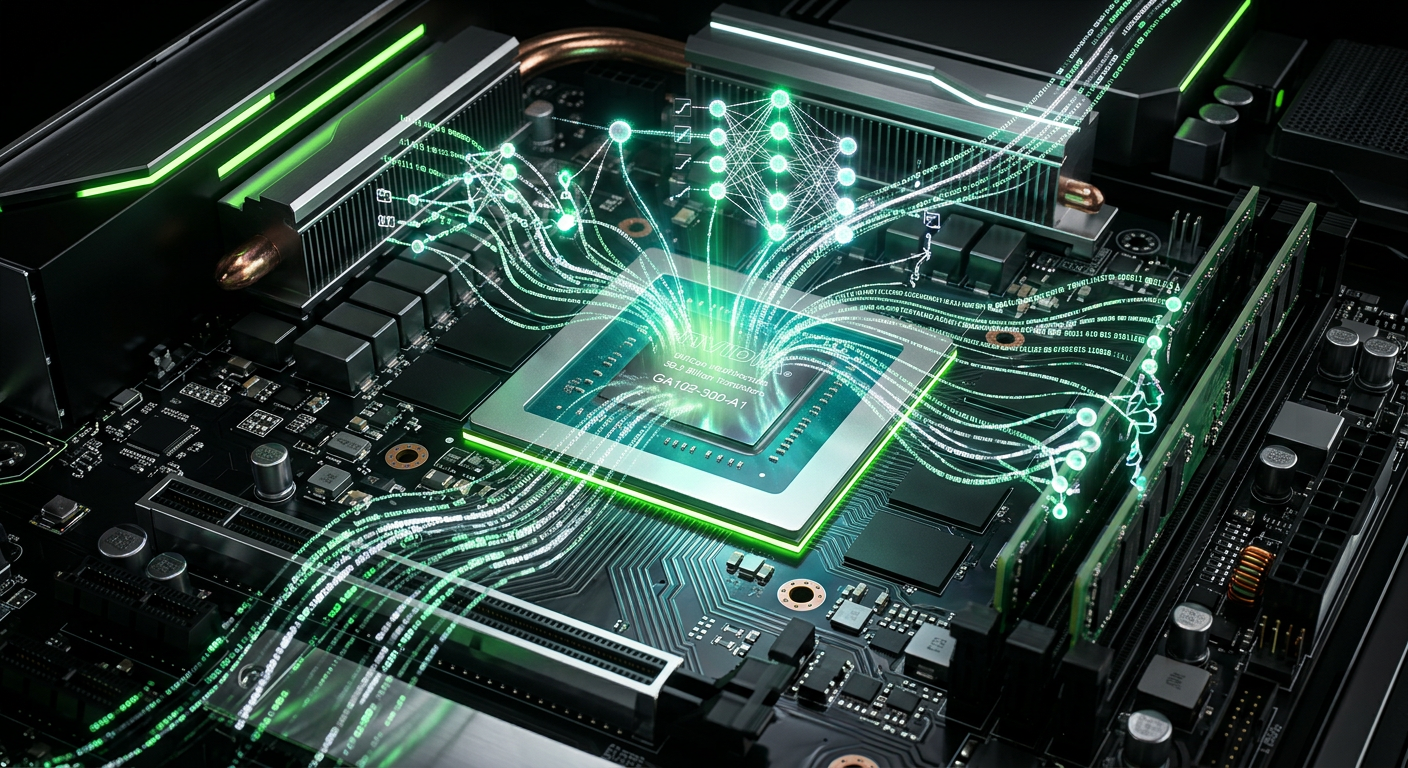
    DiffusionGemma is a 26-billion-parameter Mixture of Experts (MoE) architecture, but only 3.8 billion parameters are active during any given inference pass. This design keeps memory demands low relative to the model’s total parameter count: when quantized, DiffusionGemma fits within 18GB of VRAM, making it compatible with high-end consumer GPUs such as the NVIDIA GeForce RTX 5090 and RTX 4090.

    Speed benchmarks published alongside the release show 1,000 or more tokens per second on a single NVIDIA H100 GPU and 700 or more tokens per second on a GeForce RTX 5090. Google attributes this performance to the parallel generation architecture and to hardware-level optimizations developed with NVIDIA, including support for NVFP4 kernels on Hopper and Blackwell enterprise GPUs.

    The bidirectional attention mechanism that diffusion-based generation enables is a key technical differentiator. Because the model does not need to generate tokens strictly left to right, it can perform better on tasks where context from later in a sequence informs earlier tokens, such as code infilling, inline editing, amino acid sequence modeling, and certain mathematical graph problems. Google notes that the iterative self-correction capability of the diffusion process can also improve coherence in these non-linear generation tasks.

    Industry Impact and Reactions

    The release arrives as the open-source AI model ecosystem continues to grow more competitive. Models from Meta’s LLaMA family, Microsoft’s MAI series, and Google’s own Gemma lineup have given developers a wide range of capable open-weight options in 2026. DiffusionGemma carves out a distinct position by prioritizing throughput above all else, an approach that had not been prominently represented in Google’s open-source offerings until now.

    The co-optimization with NVIDIA is notable for a different reason: it signals a closer alignment between Google’s open-model strategy and NVIDIA’s hardware ecosystem. With AI inference increasingly distributed to on-device and edge deployments, having optimized support for consumer RTX GPUs extends the practical reach of Google’s open models beyond data center customers.

    The quality caveat Google included in the release documentation is significant for enterprise evaluators. DiffusionGemma is explicitly described as performing below standard Gemma 4 models on general-purpose quality benchmarks. For applications where output quality must meet a high bar, such as customer-facing content generation or complex reasoning tasks, the standard Gemma 4 or Gemini model lines remain the recommended choice. DiffusionGemma is aimed at workloads where speed is the binding constraint, such as real-time code suggestions, rapid document drafting pipelines, or high-throughput data processing tasks.

    What Comes Next

    Google has labeled DiffusionGemma experimental, which indicates the model does not carry production service-level commitments and that further architectural refinements are expected. The research team has not announced a specific roadmap, but the release itself is an invitation for the open-source community to build on the architecture, benchmark it against autoregressive alternatives, and identify the workload categories where diffusion-based generation offers the most meaningful advantages.

    For the broader field, the release adds momentum to a growing body of research exploring diffusion as a generation paradigm for text, not just images. If follow-on versions narrow the quality gap with autoregressive models while retaining the speed advantage, diffusion-based LLMs could shift from a niche approach to a mainstream deployment option within the next model generation cycle.

    Conclusion

    DiffusionGemma marks an interesting inflection point in open-source AI model development. By releasing a commercially licensed, NVIDIA-optimized model that achieves over 1,000 tokens per second on enterprise hardware and runs within consumer VRAM budgets, Google DeepMind has made high-throughput text generation accessible to a much wider developer audience. The quality trade-off is real and clearly acknowledged, but for the right use cases, the speed gains are substantial. As diffusion-based text generation matures, today’s experimental release may prove to be an early landmark in a significant architectural transition.

    Stay updated on the latest AI news at Evolve Digital.
  • NVIDIA RTX Spark Superchip at COMPUTEX 2026: The AI-Native Windows PC Has Arrived

    NVIDIA RTX Spark Superchip at COMPUTEX 2026: The AI-Native Windows PC Has Arrived

    NVIDIA made one of its most consequential consumer announcements in years this week at COMPUTEX 2026 in Taipei, Taiwan, unveiling the RTX Spark Superchip, an entirely new class of Windows PC processor built natively for agentic artificial intelligence. Announced during the company’s GTC Taipei keynote running alongside COMPUTEX, the chip marks NVIDIA’s formal arrival as a consumer PC platform holder alongside Intel and AMD. With 128GB of unified memory, a Blackwell-generation GPU, and Arm-based CPU cores linked by NVLink C2C, RTX Spark promises to bring data center-grade AI capabilities to laptops and desktops by fall 2026. The announcement represents a significant shift in how personal computing is defined in the age of large language models and on-device AI agents.

    What Was Announced

    NVIDIA CEO Jensen Huang took the stage in Taipei to introduce RTX Spark, describing the platform as designed to transform the Windows PC from a “tool to a teammate.” The chip is a joint effort with MediaTek, which contributes the Arm CPU architecture, paired with NVIDIA’s Blackwell GPU and its high-bandwidth NVLink C2C interconnect. The resulting configuration offers up to 20 Arm CPU cores, 6,144 CUDA cores on the Blackwell GPU, and 128GB of LPDDR5X unified memory delivering up to 300 GB/s of bandwidth.

    NVIDIA confirmed that RTX Spark systems will arrive in laptops and desktops from Dell, HP, Lenovo, ASUS, and MSI beginning in fall 2026. Microsoft is also building a new Surface Ultra laptop around the platform, signaling deep alignment between NVIDIA and Microsoft on the next generation of Windows AI PCs. Alongside the RTX Spark announcement, NVIDIA revealed DLSS 4.5 and Multi Frame Generation support, targeting 100 FPS at 1440p for gaming workloads alongside AI agent tasks.

    Also unveiled at COMPUTEX was a three-generation roadmap for the RTX Spark platform: the current Rubin-based generation with LPDDR6 memory, followed by the Rosa and then Feynman architectures. This roadmap signals NVIDIA’s long-term commitment to the consumer AI PC market as a sustained platform strategy rather than a one-time hardware experiment.

    Separately, NVIDIA confirmed that its Vera Rubin NVL72 data center platform is now ramping into full production for the second half of 2026, with early deployments underway at AWS, Google Cloud, Microsoft Azure, and Oracle Cloud.

    Technical Details

    At the heart of RTX Spark is the tight integration between the Arm CPU cores and the Blackwell GPU via NVLink C2C, NVIDIA’s chip-to-chip interconnect that eliminates the PCIe bandwidth bottleneck present in traditional discrete GPU laptop configurations. The 128GB unified memory pool is shared between the CPU and GPU, allowing large AI models including 120-billion-parameter language models to run entirely in on-device memory without offloading to slower storage. This is the same architectural principle that made Apple’s M-series unified memory designs compelling for AI inference, now applied to a Windows and CUDA ecosystem.

    NVIDIA claims the platform supports context windows of up to one million tokens, sufficient for AI agents reasoning across entire codebases, large document libraries, or extended multi-session workflows. At 300 GB/s of memory bandwidth, RTX Spark significantly outpaces current flagship Windows laptops and approaches the memory bandwidth specifications of recent high-end Mac Pro configurations.

    DLSS 4.5 with Multi Frame Generation allows the GPU to allocate substantial compute to AI workloads without sacrificing gaming or creative application performance. The technology uses AI-generated intermediate frames to maintain high frame rates with reduced raw rendering overhead, enabling the same hardware to serve both professional AI workloads and consumer gaming.

    Industry Impact and Reactions

    The RTX Spark announcement positions NVIDIA as a direct competitor in the Windows on Arm PC market, where Qualcomm’s Snapdragon X Elite platform has been the dominant force since 2024. Qualcomm has built significant OEM relationships and developer ecosystem momentum over that period, but NVIDIA’s Blackwell GPU integration and substantially higher memory bandwidth give RTX Spark a differentiated position for AI-intensive workflows that current Snapdragon configurations cannot match. For workloads like local LLM inference, long-context reasoning, and multi-agent pipelines, the hardware gap is meaningful.

    Microsoft’s decision to build a new Surface Ultra around RTX Spark indicates the company is broadening its Copilot+ PC strategy beyond its existing Qualcomm alignment, acknowledging that different AI workload profiles may require different silicon architectures. HP has already announced PCs built around the RTX Spark platform, underscoring early OEM commitment ahead of the fall launch window.

    For software developers and enterprises building AI-native Windows applications, RTX Spark offers an on-device inference platform capable of running frontier-class open-weight models locally. This capability reduces cloud inference costs and addresses data sovereignty and privacy requirements for regulated industries that cannot route sensitive information through external APIs. The combination of CUDA compatibility and the existing NVIDIA developer ecosystem gives RTX Spark a software readiness advantage that new Arm-based platforms have historically struggled to achieve quickly.

    What Comes Next

    RTX Spark-powered laptops and desktops are expected to begin shipping from OEM partners in fall 2026, with the Microsoft Surface Ultra among the first high-profile devices to reach consumers. NVIDIA’s published three-generation platform roadmap — Rubin, Rosa, and Feynman — suggests a regular upgrade cadence for the RTX Spark line as LPDDR6 memory and subsequent GPU generations become available.

    Critical to the platform’s success will be NVIDIA’s developer tooling rollout, including full CUDA and TensorRT support optimized for the new Arm-plus-Blackwell configuration, as well as integration with its NIM microservices framework for enterprise AI deployment. Pricing for RTX Spark systems has not yet been announced; how NVIDIA and its OEM partners position the platform relative to existing Copilot+ PCs and Apple M-series MacBooks will significantly shape adoption in the professional market.

    Conclusion

    NVIDIA’s RTX Spark Superchip represents one of the most significant shifts in consumer PC architecture in over a decade, extending the company’s AI hardware dominance from hyperscale data centers all the way to the laptop on a professional’s desk. With Microsoft, Dell, HP, Lenovo, ASUS, and MSI committed as launch partners, RTX Spark has the ecosystem backing to challenge the existing Windows on Arm market and redefine expectations for personal AI computing. The coming months will reveal how pricing and software ecosystem development translate NVIDIA’s hardware engineering achievements into real-world adoption, but the platform’s arrival at COMPUTEX 2026 marks an unmistakable inflection point in the AI PC race.

    Stay updated on the latest AI news at Evolve Digital.

  • Nvidia CEO Jensen Huang Unveils Ising: The World First Family of Open-Source Quantum AI Models

    Nvidia CEO Jensen Huang Unveils Ising: The World First Family of Open-Source Quantum AI Models

    Nvidia CEO Jensen Huang announced the creation of Nvidia Ising, described as the world first family of open-source quantum AI models, on May 9, 2026. The announcement positions Nvidia at the intersection of two of the most consequential technology bets of the decade: large-scale AI and quantum computing. While commercially viable quantum computing remains years away, the Ising model family represents Nvidia opening move in defining what AI-optimized quantum software might look like when that hardware becomes available.

    What Was Announced

    Jensen Huang announced at an investor event that Nvidia had developed the Ising model family, a set of open-source AI models designed to interface with and accelerate optimization problems that quantum computing architectures are particularly suited to solve. The name references the Ising model from statistical mechanics, a mathematical framework used to model spin interactions in physical systems that has become a foundational benchmark problem for quantum computers.

    The models are being released as open source, consistent with Nvidia strategy across several of its AI research initiatives. Making the models publicly available allows the broader quantum computing and AI research communities to build on them, accelerating development of the tools and workflows needed to make quantum-classical hybrid computing practical for real workloads. Nvidia has positioned itself not as a quantum hardware company but as a software and systems integrator that can bridge quantum hardware from companies like IonQ, IBM, and others with the AI frameworks that developers already know.

    Nvidia described Ising as part of its broader push to integrate quantum computing into its simulation and optimization workflows. The company has existing quantum computing partnerships and has incorporated quantum circuit simulation into its cuQuantum software library. Ising extends that foundation toward AI-native interfaces for quantum problem-solving.

    Technical Details

    The Ising model family is designed around optimization problems — a class of computations that quantum hardware handles particularly well compared to classical systems. Optimization problems appear throughout AI and industrial applications: scheduling, logistics, financial portfolio construction, drug molecule discovery, and materials science simulations are all domains where quantum-optimized solutions could offer significant advantages when hardware matures.

    The models are designed as open-source artifacts that developers can adapt to specific problem domains. Nvidia approach of releasing them under an open license means the research community can extend them to new problem types and hardware backends without waiting for proprietary tools. This positions Nvidia standards and frameworks as the natural foundation for quantum AI development even before quantum hardware achieves commercial viability.

    Nvidia already operates one of the most widely adopted AI software stacks through CUDA, cuDNN, and its associated ecosystem. Extending that stack into the quantum domain through open-source models follows the same playbook: establish the software foundation early and let hardware adoption follow. When commercial quantum hardware eventually arrives at meaningful scale, developers trained on Nvidia quantum tools will likely continue using them.

    Industry Impact and Reactions

    The announcement has drawn attention from both the AI and quantum computing communities. For quantum computing researchers, Nvidia entry as an open-source model provider lends significant institutional weight to efforts to define quantum AI standards. For AI developers, the announcement signals that the GPU giant is thinking seriously about what comes after classical accelerators, even if the timeline remains uncertain.

    Nvidia is not the first major technology company to invest in quantum AI research. Google, IBM, and Microsoft have all built significant quantum computing programs, and all have explored the intersection of quantum hardware with AI workloads. But Nvidia unique position as the dominant supplier of AI training and inference infrastructure gives its quantum AI efforts a distinctive reach: when Nvidia defines what quantum AI software looks like, developers who depend on CUDA have strong incentives to align with that vision.

    Financial analysts covering Nvidia noted that the Ising announcement does not affect the company near-term revenue outlook, which remains overwhelmingly dependent on classical GPU sales. But for investors with a multi-decade horizon, the move is consistent with a pattern of early positioning in transformative technology categories that Nvidia has executed successfully across GPU computing, deep learning, and autonomous vehicles.

    What Comes Next

    Nvidia has not disclosed a specific timeline for when Ising models will be available for download or what quantum hardware backends will be supported at launch. The company is expected to share additional technical details at a forthcoming developer event. In the meantime, the announcement is likely to drive collaboration between Nvidia and quantum hardware providers eager to align their roadmaps with Nvidia open-source software infrastructure.

    Broader commercial quantum advantage in optimization problems is generally expected to emerge in the early-to-mid 2030s based on current hardware trajectories. The Ising model release positions Nvidia to be the software ecosystem of choice when that transition happens.

    Conclusion

    Nvidia release of the Ising open-source quantum AI model family is an early but strategically significant move in what may become one of the most important technology transitions of the coming decade. By establishing an open-source software foundation at the intersection of AI and quantum computing now, Nvidia is following the same playbook that made it the dominant force in classical AI infrastructure — planting a flag early, building developer alignment, and waiting for hardware to mature around its software ecosystem.

    Stay updated on the latest AI news at Evolve Digital.