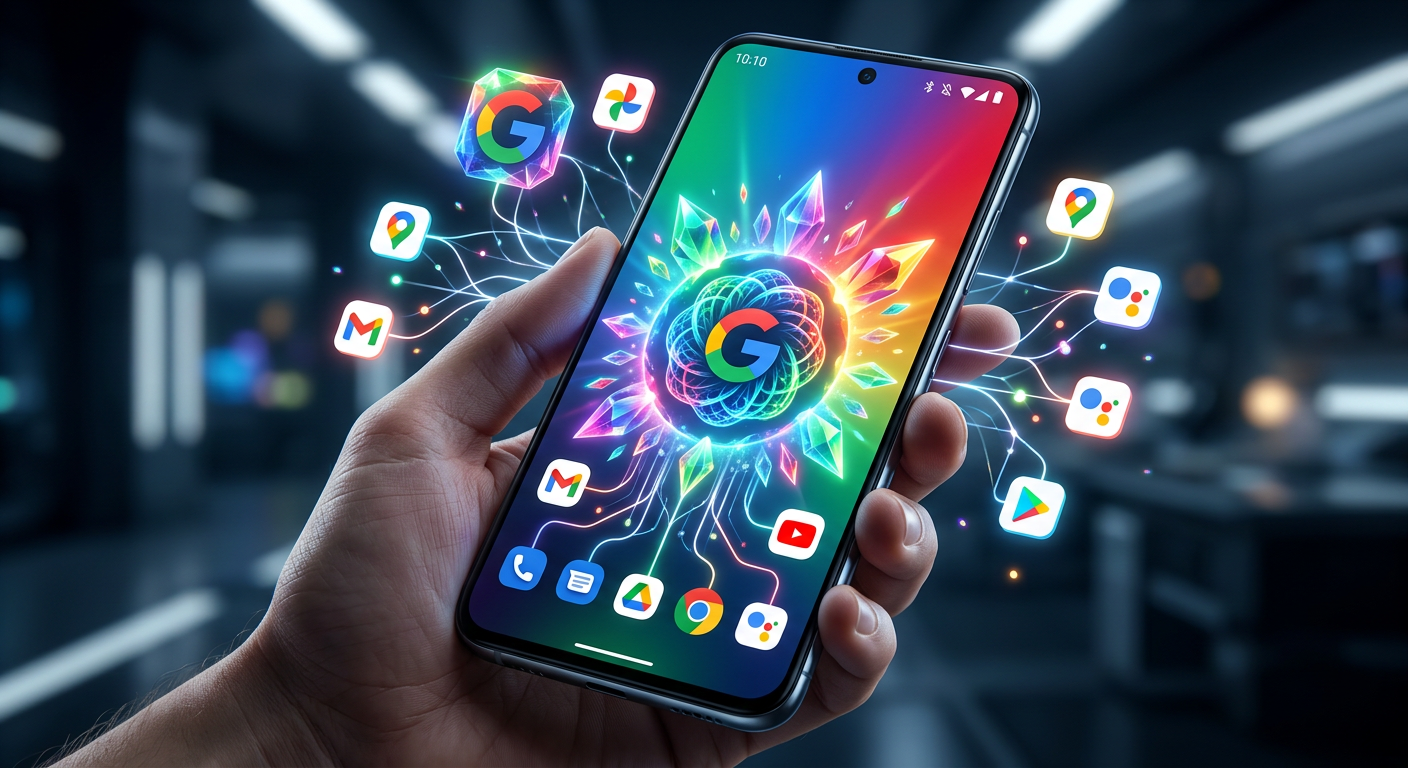
Google unveiled Gemini Intelligence on May 12, 2026, its most comprehensive AI push for Android yet — a suite of deeply integrated, cross-app AI capabilities that goes far beyond a chatbot. Unlike earlier iterations of Google AI on Android, Gemini Intelligence is designed to understand what is happening on-screen across any application and take action on a user’s behalf. The announcement positions Google’s Gemini as the connective tissue of the entire Android ecosystem, capable of completing complex tasks that previously required jumping between multiple apps.
What Was Announced
Gemini Intelligence is Google’s new overarching brand for its AI feature set on Android. The defining characteristic of the new platform is ambient, cross-app awareness: rather than operating within a single context or chat window, Gemini Intelligence can follow a task from start to finish across multiple applications. A user could, for example, ask it to find a restaurant near a location mentioned in a message, check availability, and add the reservation to their calendar — all without manually switching between apps.
Two standout features debuted with the announcement. The first is Rambler, a Gboard integration that uses Gemini to polish spoken messages into clean, readable text. Users can speak naturally, and Rambler handles the editing — converting rough voice input into polished prose before it is sent. The second is generative widget creation: users can describe the kind of widget they want in natural language, and Gemini Intelligence will build it for them dynamically, without requiring a developer or an app update.
Google is rolling out Gemini Intelligence in waves. The first devices to receive the features are the latest Samsung Galaxy and Google Pixel phones. From there, the rollout is expected to expand to Android watches, Android Auto in cars, the forthcoming Android XR glasses, and Google-powered laptops from Acer, ASUS, and Lenovo. This device-spanning approach reflects Google’s ambition to make Gemini a consistent AI layer across every screen a person uses throughout their day.
Technical Details
The core technical enabler behind Gemini Intelligence is on-screen context understanding. Gemini Intelligence does not just respond to typed queries — it reads what is visible on the display and uses that information to inform its actions. This requires a model with strong vision and language capabilities running with low enough latency to feel responsive in real time, integrated tightly with Android’s accessibility and activity management systems.
Generative widget creation represents a particularly interesting capability. Traditional Android widgets are static code artifacts created by app developers. Gemini Intelligence generates widget layouts dynamically based on user intent expressed in natural language, meaning users can request a custom at-a-glance view for tracking a sports team’s schedule, a reminder widget tuned to a specific workflow, or a summary card for a category of notifications. The infrastructure to support this is a combination of on-device inference and cloud API calls, routed to minimize latency and preserve privacy where possible.
The cross-app task completion capability depends heavily on Android’s permission and intents model. Gemini Intelligence interacts with applications through system-level APIs rather than simulated user input, which means it can take reliable action inside apps rather than just mimicking taps. Google has indicated enterprise administrators will be able to configure exactly which actions the AI layer is permitted to take, addressing workplace security concerns about autonomous AI operating on corporate devices.
Industry Impact and Reactions
The timing of the Gemini Intelligence announcement is significant. Google is in direct competition with Apple for AI mindshare on mobile, and Apple is expected to unveil a sweeping overhaul of Siri at WWDC 2026 in June, alongside expanded Apple Intelligence features for iOS 27. The Google announcement effectively raises the bar one month before Apple’s own showcase, giving Gemini Intelligence a brief window of attention before the industry’s focus shifts to Cupertino.
For Samsung, which ships the largest volume of premium Android devices globally, the deep integration of Gemini Intelligence represents a major bet on Google’s AI roadmap. Samsung has historically maintained its own AI product, Galaxy AI, and the deeper Gemini integration suggests a growing alignment — or at minimum a pragmatic recognition that Google’s AI investment exceeds what Samsung can replicate independently.
On the developer side, the generative widget system raises questions about how traditional widget developers will adapt. If users can generate widgets on demand through natural language, there is less incentive to seek out and install purpose-built widget apps. This could represent a meaningful disruption to a segment of the Android app ecosystem that has historically been insulated from AI-driven change.
What Comes Next
Google I/O 2026 is expected to bring additional Gemini Intelligence announcements, including the launch of a new Gemini model that Google is positioning as competitive with the current frontier — described in reporting as landing roughly in the class of OpenAI’s recent flagship model rather than pushing beyond it. Additional Android XR integrations are also expected, as Google prepares to launch its wearable glasses hardware later this year.
The broader rollout across watches, cars, and laptops is expected throughout summer and fall 2026. Google has not committed to a firm timeline for when Gemini Intelligence will reach mid-range Android devices, which represent the majority of global Android shipments. That expansion will be a key test of whether the features can scale beyond premium flagship hardware.
Conclusion
Gemini Intelligence represents Google’s most ambitious attempt yet to make AI a fundamental layer of the Android operating system rather than an add-on feature. By enabling cross-app task completion, dynamic widget generation, and voice input refinement, Google is betting that users want an AI that does things — not just one that answers questions. As mobile AI competition intensifies ahead of Apple’s WWDC, the Gemini Intelligence launch stakes out an aggressive position that will define the AI smartphone narrative through the rest of 2026.
Stay updated on the latest AI news at Evolve Digital.