Tag: AI Investment

  • Alibaba Raises $10.2 Billion in Record Hong Kong Share Sale to Accelerate Full-Stack AI Push

    Alibaba Raises $10.2 Billion in Record Hong Kong Share Sale to Accelerate Full-Stack AI Push

    On August 23, 2026, Alibaba Group Holding launched a HK$80 billion ($10.2 billion) share placement on the Hong Kong Stock Exchange, directing 100 percent of the proceeds toward artificial intelligence development. The offering marks the largest primary follow-on share sale ever conducted by a Hong Kong-listed company and ranks as the world’s third-largest primary follow-on share sale of 2026, behind only recent offerings from Alphabet and Intel. The placement is expected to close on August 26, 2026, subject to customary conditions.

    What Was Announced

    Alibaba priced 710 million ordinary shares at HK$112.70 each, a 3.6 percent discount to its most recent closing price. At that price, the total offering amounts to approximately HK$80 billion, or roughly $10.2 billion USD — a figure that places the deal in rare company among this year’s global capital markets activity.

    In its announcement, Alibaba stated that 100 percent of the net proceeds will be invested in what it describes as “full stack” AI capabilities. That phrase covers the entire AI technology chain: chip procurement, cloud and AI infrastructure buildout, and the development and deployment of AI models across the company’s platforms.

    The scale of the placement reflects a strategic decision to treat AI infrastructure as a multi-year, capital-intensive program rather than an incremental product investment. By committing the full proceeds to a single category, Alibaba is signaling that it views ownership of the complete AI stack — from silicon to software — as a core competitive priority.

    The placement was expected to close on August 26, 2026, with the shares offered through an accelerated book-building process to institutional investors.

    Technical Details

    The “full stack” framing Alibaba used for the investment encompasses three distinct technology layers. At the hardware layer, the company is expected to expand its chip capabilities, including its proprietary Yitian series of Arm-based data center processors, which it has developed as a counterpart to the GPU-heavy infrastructure favored by Western hyperscalers. Additional capital at this layer could accelerate Yitian development timelines or fund procurement of high-performance accelerators for AI training workloads.

    At the infrastructure layer, Alibaba Cloud operates data centers across China and internationally. AI workloads demand significantly more compute, memory bandwidth, and networking capacity than conventional cloud applications, and the company’s AI-oriented infrastructure investment is expected to include new and upgraded facilities designed specifically for large-scale model training and inference.

    At the model layer, Alibaba’s Tongyi Qianwen (Qwen) family of large language models has performed competitively in open-weight benchmarks globally. The company offers model access through Alibaba Cloud’s Model Studio platform, and additional capital directed at model development suggests continued iteration on the Qwen series and potentially new multimodal or specialized model variants. More deployment-stage funding could mean expanded capacity on Model Studio to serve enterprise customers at greater scale.

    Industry Impact and Reactions

    The share sale arrives at a moment of intense AI investment activity across both Chinese and Western technology companies. In China, Alibaba competes with Baidu, Tencent, ByteDance, and Huawei — all of which have made substantial AI investments in recent years. A $10.2 billion injection gives Alibaba one of the largest single capital commitments in the domestic AI infrastructure race and could accelerate its ability to compete across model development, cloud services, and enterprise AI products.

    Internationally, the deal puts Alibaba’s AI capital raise in the same league as offerings from Alphabet and Intel this year, illustrating that the global appetite for AI infrastructure funding is not limited to US-based companies. Investors and analysts tracking Chinese tech have noted that Alibaba’s pivot toward AI has been one of the more significant strategic shifts of the past two years, as the company has sought to reorient its cloud and enterprise business around AI-driven offerings.

    Markets responded cautiously to the dilutive share sale. Alibaba’s Hong Kong-listed shares fell 8.5 percent on Monday, August 24, their steepest single-day decline since early 2025. The drop reflects a common market reaction to large follow-on offerings, where dilution concerns can weigh on price in the short term even when the stated use of proceeds is viewed favorably over a longer horizon.

    What Comes Next

    The placement is scheduled to close on August 26, 2026. Once funds are received, the specific allocation across chip procurement, infrastructure projects, and model initiatives will be guided by Alibaba’s internal capital planning processes. The company has not publicly outlined a timeline for individual investments or named specific projects the funds will support.

    Investors and technology observers will be monitoring Alibaba Cloud’s AI revenue trajectory and any announcements around new Qwen model releases, data center expansions, or chip partnerships that might offer visibility into how the $10.2 billion is being deployed. The company’s next earnings report will likely be the first meaningful opportunity to measure early progress against this commitment.

    Conclusion

    Alibaba’s record-breaking $10.2 billion share placement is a clear statement that the global AI infrastructure build-out is entering a new phase of capital intensity — and that Chinese technology companies intend to compete at the frontier. By committing the entire proceeds to full-stack AI development, Alibaba is placing a substantial bet that owning chips, compute, and models together will be the decisive advantage in a rapidly evolving market. With the placement closing later this week, attention will quickly shift to how and where the company begins putting that capital to work.

    Stay updated on the latest AI news at Evolve Digital.
  • Nvidia Pays Poolside $6 Billion to License AI Model Factory in Landmark Deal

    Nvidia Pays Poolside $6 Billion to License AI Model Factory in Landmark Deal

    Nvidia has committed a combined $7 billion to Poolside AI in one of the most unconventional arrangements in the history of the artificial intelligence industry — paying $6 billion to license the startup’s proprietary model-building technology while simultaneously investing $1 billion in the company at a $12 billion pre-money valuation. The deal, which broke on August 20, 2026, gives Nvidia access to Poolside’s “Model Factory” software and brings 109 of its engineers into the chip giant’s workforce, all without triggering a traditional acquisition. The structure signals a new phase in AI’s consolidation era, where deep-pocketed incumbents are finding creative ways to absorb intellectual property and talent while sidestepping the regulatory scrutiny that full buyouts increasingly invite.

    What Was Announced

    Poolside AI, founded in 2024 and focused on building AI models purpose-built for software development tasks, has signed a non-exclusive $6 billion licensing agreement with Nvidia covering the company’s Model Factory — the internal system Poolside engineered to train its own AI models. Separately, Nvidia is making a $1 billion equity investment in Poolside at a pre-money valuation of $12 billion, bringing its total financial commitment to $7 billion.

    As part of the arrangement, approximately 109 Poolside employees will receive job offers from Nvidia. The startup’s founders, however, are not departing. They will remain at the helm of Poolside, which continues to operate as an independent company with the ability to license the same Model Factory technology to third parties — a fact that distinguishes this deal sharply from a conventional acquisition.

    The terms were disclosed in a letter to investors obtained by Newcomer, and were subsequently confirmed by reporting from The Information, TechCrunch, and The Next Web. The deal structure was described explicitly by Poolside’s investor communications as “not an acquisition and not an acquihire,” underscoring the deliberate effort to maintain Poolside’s independence while transferring substantial technology rights and workforce to Nvidia.

    Technical Details

    The centerpiece of the transaction is Poolside’s Model Factory — a proprietary software system the company developed to train its domain-specific AI models. Rather than simply licensing a finished model, Nvidia is licensing the system used to build models, which gives it far more flexibility. A model-building platform can be applied across many tasks, hardware configurations, and training regimes, making it a more durable and versatile asset than any individual model output.

    Poolside’s core product focus has been on AI models optimized for code generation and software engineering workflows — a domain that Nvidia, which sells the hardware underpinning virtually all AI training, has a strong strategic interest in expanding. By integrating Poolside’s Model Factory, Nvidia gains a repeatable method for training high-performance AI models that could be applied to its growing suite of enterprise AI software products, including NIM microservices and its AI Enterprise platform.

    The non-exclusive nature of the license is technically significant. Poolside retains the right to license the same technology to competing parties — including, in principle, Nvidia’s own hardware rivals and hyperscaler customers. This is unusual for a $6 billion payment and suggests the deal may be as much about speed and talent access as it is about exclusivity. Nvidia apparently valued immediate access and team absorption over locking out competitors.

    Industry Impact and Reactions

    The Poolside deal follows a pattern that has emerged among the largest AI companies: structuring transactions that deliver the operational benefits of an acquisition — key personnel, proprietary technology, strategic control — without the full legal and regulatory exposure of a buyout. Microsoft’s relationship with Inflection AI, Amazon’s investment structure with Anthropic, and Google’s similar arrangement with DeepMind’s successor companies have all explored adjacent territory. Nvidia’s Poolside deal takes this further by combining a licensing payment of unprecedented size with a minority equity stake and direct team recruitment.

    For the broader AI industry, the deal reinforces Nvidia’s stated ambition to become a full-stack AI company rather than simply a chip supplier. CEO Jensen Huang has spoken repeatedly about Nvidia’s desire to own the “computing stack” from silicon through software and models. Paying $6 billion for a software license — rather than for hardware, factories, or physical infrastructure — is a striking demonstration of that strategic direction.

    The deal also reflects the scarcity value of advanced model-training expertise. Poolside’s Model Factory represents years of specialized engineering work on training pipelines, data curation, and evaluation frameworks. In an industry where the gap between leading and lagging organizations often comes down to training efficiency, Nvidia is treating that expertise as worth billions even without exclusive rights.

    What Comes Next

    The 109 Poolside engineers who receive Nvidia job offers will likely be integrated into teams working on Nvidia’s AI Enterprise software stack and its NIM inference microservices. The Model Factory licensing terms are expected to govern how and where Nvidia can deploy the technology, though specifics have not been disclosed publicly. Poolside, now well-capitalized with a fresh $1 billion investment, is expected to continue product development and explore additional licensing partnerships enabled by the non-exclusive structure of the Nvidia agreement.

    Regulatory review of the deal is not expected to pose significant barriers given that no acquisition of the company is taking place, but antitrust observers will likely watch how Nvidia uses the Model Factory technology and whether the company pursues further licensing or equity deals with other frontier AI labs. The next major question for the industry is whether Poolside’s founders and remaining team can maintain momentum and competitive relevance as more than 100 of their colleagues migrate to one of the largest corporations in the world.

    Conclusion

    Nvidia’s $7 billion commitment to Poolside is the clearest signal yet that the competition in AI is no longer limited to chips and data centers — it now extends to the pipelines and platforms used to build AI models themselves. By licensing rather than acquiring, Nvidia has found a way to accelerate its software ambitions while avoiding the friction of a full buyout, setting a template that other AI heavyweights will likely study closely. For Poolside, the deal validates its technical approach and leaves it financially positioned to remain a meaningful player in the AI model-building space on its own terms.

    Stay updated on the latest AI news at Evolve Digital.
  • Anthropic Posts First Quarterly Profit as Revenue Surges 14x to $11.5 Billion, Targeting $2 Trillion IPO

    Anthropic Posts First Quarterly Profit as Revenue Surges 14x to $11.5 Billion, Targeting $2 Trillion IPO

    Anthropic has reached a landmark financial milestone: the AI safety company reported preliminary second-quarter 2026 revenue exceeding $11.5 billion, a 14-fold surge compared to $787 million in the same period last year. Alongside this revenue explosion, the company recorded positive adjusted operating income for the first time, signaling that one of the world’s most closely watched AI labs is approaching profitability at extraordinary scale. With a confidential SEC IPO filing already submitted in June, investors are now targeting a $2 trillion valuation for Anthropic’s public debut, which would make it the largest initial public offering in history.

    What Was Announced

    Anthropic’s Q2 2026 revenue of more than $11.5 billion represents nearly triple the $4.73 billion the company recorded in Q1 2026, and more than 14 times the $787 million generated in Q2 2025. The figures were reported by Bloomberg and confirmed by multiple outlets including CNBC and Fortune, citing people familiar with Anthropic’s internal investor communications.

    The company’s annualized revenue run rate has now surpassed $65 billion as of mid-August 2026, up from approximately $47 billion in May when Anthropic first publicly acknowledged it had reached that level. Investors and analysts expect Anthropic’s annualized revenue to reach between $100 billion and $120 billion by the end of 2026 if current growth rates hold.

    Crucially, Anthropic also reported positive adjusted operating income for Q2, marking the first quarter in the company’s history where it covered its costs and generated a surplus on an adjusted basis. The company had previously burned through capital at a rapid pace to fund model training, data center expansion, and safety research. The shift to adjusted profitability is seen as a critical signal ahead of the anticipated public offering.

    Anthropic confidentially filed its IPO prospectus with the U.S. Securities and Exchange Commission in June 2026 and is expected to list on U.S. public markets as early as late September or October 2026. The company, led by CEO Dario Amodei and President Daniela Amodei, has not publicly confirmed the IPO timeline, but multiple investor sources have told financial media that preparations are well underway.

    Technical Details

    The revenue surge is driven primarily by demand for Anthropic’s Claude family of models, which now includes Claude Opus 5, Claude Sonnet, and Claude Haiku. These models have seen rapid enterprise adoption across coding, content generation, customer support, document analysis, and agentic task automation. The launch of Claude Opus 5 earlier in 2026, which achieved perfect scores on mathematical benchmarks and posted frontier-level performance on software engineering evaluations, appears to have been a significant commercial catalyst.

    Anthropic’s infrastructure buildout has been central to its ability to scale revenue. A deepened partnership with Google Cloud, combined with a new compute arrangement announced alongside Broadcom for multiple gigawatts of next-generation compute capacity, has allowed Anthropic to serve a dramatically higher volume of API requests and Claude.ai enterprise customers. The company’s Theseus joint venture for dedicated AI data centre infrastructure was announced earlier this year and is expected to further reduce reliance on third-party cloud margins as it comes online.

    The company’s API platform serves a large and growing base of enterprise software developers building applications on top of Claude. Anthropic has also expanded its direct enterprise offerings, including the Claude Team and Enterprise tiers on Claude.ai, which provide organisations with higher context windows, custom system prompts, and administrative controls that large businesses require before deploying AI at scale internally.

    Industry Impact and Reactions

    Anthropic’s financial trajectory has reshaped the competitive narrative in the AI industry. For much of 2024 and early 2025, OpenAI was considered the clear market leader by revenue, with Anthropic seen as an important but smaller rival focused on safety research. The 14-fold year-over-year revenue growth reported for Q2 2026 positions Anthropic as a company whose revenue trajectory may be outpacing even OpenAI’s in percentage terms, though absolute revenue comparison between the two private companies remains difficult given incomplete disclosures.

    A $2 trillion IPO valuation, if achieved, would exceed the current market capitalisation of all but a handful of companies globally, including established tech giants like Alphabet and Meta. The figure has prompted significant debate among investors and analysts. Some argue the valuation is justified by Anthropic’s growth rate and the transformational potential of AI in the enterprise; others, including Fortune and Forbes commentators, have raised concerns about the compute cost structure, intensifying competition from open-source models, and the gap between adjusted operating income and full GAAP profitability.

    The news lands against a backdrop of extraordinary fundraising across the AI sector. Anthropic has previously raised capital from Google, Amazon, and Spark Capital, among others, at a $965 billion private valuation in May 2026. Should the IPO proceed at $2 trillion, early investors would see substantial returns. The debut would also surpass SpaceX’s June 2026 IPO at $1.77 trillion, which itself set the record for the largest public market debut ever at the time.

    What Comes Next

    Anthropic is expected to file a public S-1 registration statement with the SEC in the coming weeks, which will provide investors with audited financials, full risk disclosures, and details on the company’s path to sustained GAAP profitability. The IPO roadshow is anticipated to begin in September 2026, with trading expected to commence in late September or October depending on market conditions and regulatory review.

    The company has not announced a stock exchange listing venue, though both the New York Stock Exchange and Nasdaq have reportedly engaged with Anthropic’s advisors. Key milestones to watch include the public S-1 filing, the IPO price range disclosure, and the roadshow presentations, which will offer the first comprehensive look at Anthropic’s financials, safety research investments, and long-term business model for public market investors.

    Conclusion

    Anthropic’s Q2 2026 results represent a defining moment not just for the company but for the broader AI industry. A 14-fold revenue surge combined with a first-ever adjusted operating profit, followed by what could be the largest IPO in history, underscores how rapidly the commercial AI landscape has matured. For enterprise technology buyers, developers, and investors alike, Anthropic’s trajectory offers a compelling data point on the near-term economic scale of the generative AI transition.

    Stay updated on the latest AI news at Evolve Digital.

  • Anthropic Launches Theseus Infrastructure: A Joint Venture to Build Purpose-Built AI Data Centres

    Anthropic Launches Theseus Infrastructure: A Joint Venture to Build Purpose-Built AI Data Centres

    Anthropic announced the formation of Theseus Infrastructure on August 11, 2026, a joint venture with Macquarie Asset Management and Singapore’s sovereign wealth fund GIC, created to build purpose-built US data centres for the company’s AI workloads. The deal marks a significant strategic shift for Anthropic, moving from leasing compute capacity from major cloud providers to co-owning the physical infrastructure that powers its Claude models. With Macquarie and GIC holding the majority equity stake and Anthropic serving as the anchor tenant under long-term leases, the venture mirrors similar infrastructure plays by OpenAI and xAI in recent years. The announcement positions Anthropic as a company investing seriously not just in model development, but in the full stack of AI infrastructure.

    What Was Announced

    On August 11, 2026, Anthropic revealed the creation of Theseus Infrastructure, a joint venture established in partnership with Macquarie Asset Management, one of the world’s largest infrastructure investment managers, and GIC, Singapore’s sovereign wealth fund. The venture’s purpose is to design and build data centres in the United States specifically optimised for the computational demands of frontier AI model training and inference.

    Under the structure of the deal, Macquarie Asset Management and GIC own and fund the majority equity stake in Theseus Infrastructure. Anthropic enters the arrangement as the anchor tenant, committing to long-term leases of the facilities being built. In a notable provision, Anthropic has agreed to cover 100% of grid-upgrade costs associated with the new data centres, as well as any increases in consumer electricity prices that result from the increased power demand. No total investment figure was publicly disclosed by any of the parties involved.

    The name “Theseus” is an evocative choice. In Greek mythology, Theseus was the hero who navigated the labyrinth — a fitting metaphor for a company charting a path through the complex and rapidly evolving landscape of AI compute infrastructure. Whether or not the branding is intentional on that level, the venture’s ambitions are clear: to give Anthropic greater control over its most critical operational resource.

    Bloomberg first reported the announcement, and the formation of Theseus Infrastructure was confirmed by Anthropic’s communications team on August 11, 2026.

    Technical Details

    The data centres being built under Theseus Infrastructure will be purpose-built for AI workloads, meaning they are designed from the ground up to meet the specific requirements of large-scale model training and high-throughput inference rather than repurposed from general-purpose commercial facilities.

    Purpose-built AI data centres differ from conventional cloud infrastructure in several key ways. They are engineered for extremely high power density per rack, often exceeding 100 kilowatts per rack compared to the 10 to 20 kilowatts typical in standard enterprise data centres. They require specialised cooling systems, including liquid cooling and direct-to-chip cooling, to manage the heat output of GPU and AI accelerator clusters. They also demand different networking architectures involving high-bandwidth, low-latency interconnects to allow GPUs to communicate efficiently during distributed training runs.

    Anthropic’s agreement to cover 100% of grid-upgrade costs is technically significant. Building AI data centres at scale often requires substantial upgrades to local electrical grid infrastructure, including new substations, transformer upgrades, and transmission lines. By absorbing these costs directly, Anthropic accelerates the construction timeline and removes a common negotiating obstacle that can delay data centre projects by years.

    Industry Impact and Reactions

    Theseus Infrastructure places Anthropic firmly in a growing trend among frontier AI labs: direct ownership or co-ownership of the physical infrastructure underlying their AI systems. OpenAI, through its partnership with Microsoft and its own infrastructure investments, has been building toward dedicated compute capacity for several years. Elon Musk’s xAI constructed a massive GPU cluster, known as Colossus, in Memphis, Tennessee, in 2025. Meta has publicly committed to spending over $60 billion on data centre infrastructure in 2025 alone.

    For Anthropic, which has historically relied heavily on cloud compute provided by Amazon Web Services and Google Cloud, this move signals a desire for greater independence and control. Leasing from hyperscalers provides flexibility, but it also means capacity and costs are subject to external factors. Co-owning infrastructure through a purpose-built joint venture allows Anthropic to lock in capacity at a predictable cost, customise facilities to its exact technical requirements, and reduce dependency on third-party providers.

    The involvement of Macquarie Asset Management and GIC as majority equity holders is strategically notable. Both are long-term infrastructure investors accustomed to large capital commitments and multi-decade return horizons. Their participation provides Anthropic with a well-capitalised infrastructure partner without requiring Anthropic to deploy all of the capital itself, preserving the company’s balance sheet for research and product development.

    What Comes Next

    No specific construction timeline or facility locations were disclosed in the August 11 announcement. Given the scale of purpose-built AI data centre projects, which typically take two to four years from groundbreaking to operational capacity, Theseus Infrastructure’s first facilities are unlikely to be operational before 2028 or 2029. In the interim, Anthropic is expected to continue using its existing cloud partnerships with AWS and Google Cloud to meet near-term compute demand.

    The deal also raises broader questions about the evolving relationship between AI labs and the wider infrastructure economy. As frontier AI training runs require ever-larger compute clusters and ever-more power, the distinction between a technology company and an infrastructure company is blurring. Theseus Infrastructure is Anthropic’s clearest signal yet that it intends to be both.

    Conclusion

    The formation of Theseus Infrastructure represents a milestone in Anthropic’s evolution from a research-focused AI lab into a full-stack AI company. By partnering with Macquarie Asset Management and GIC to build purpose-built US data centres, Anthropic is securing the physical foundation it needs to remain competitive as AI capabilities and compute demands continue to scale. For an industry where access to compute is increasingly the determining factor in what is technically possible, owning the infrastructure is no longer optional for those who intend to lead.

    Stay updated on the latest AI news at Evolve Digital.
  • Nvidia Moves to Backstop $250 Billion in OpenAI’s Ohio Data Center Financing in Historic Infrastructure Deal

    Nvidia Moves to Backstop $250 Billion in OpenAI’s Ohio Data Center Financing in Historic Infrastructure Deal

    Nvidia is in early-stage talks to provide up to $250 billion in financial guarantees to help OpenAI secure the lease on a 10-gigawatt data center campus in southern Ohio, The Wall Street Journal reported on July 26, 2026. The deal, if finalized, would represent one of the largest single corporate financing commitments in technology industry history. Separately, Nvidia is also in discussions to back up to $350 billion in chip purchases for the same facility, bringing the chipmaker’s total potential exposure to $600 billion. For OpenAI, the arrangement would mark a decisive shift in strategy: moving the company from renting compute from cloud partners toward controlling its own infrastructure at a scale never before attempted.

    What Was Announced

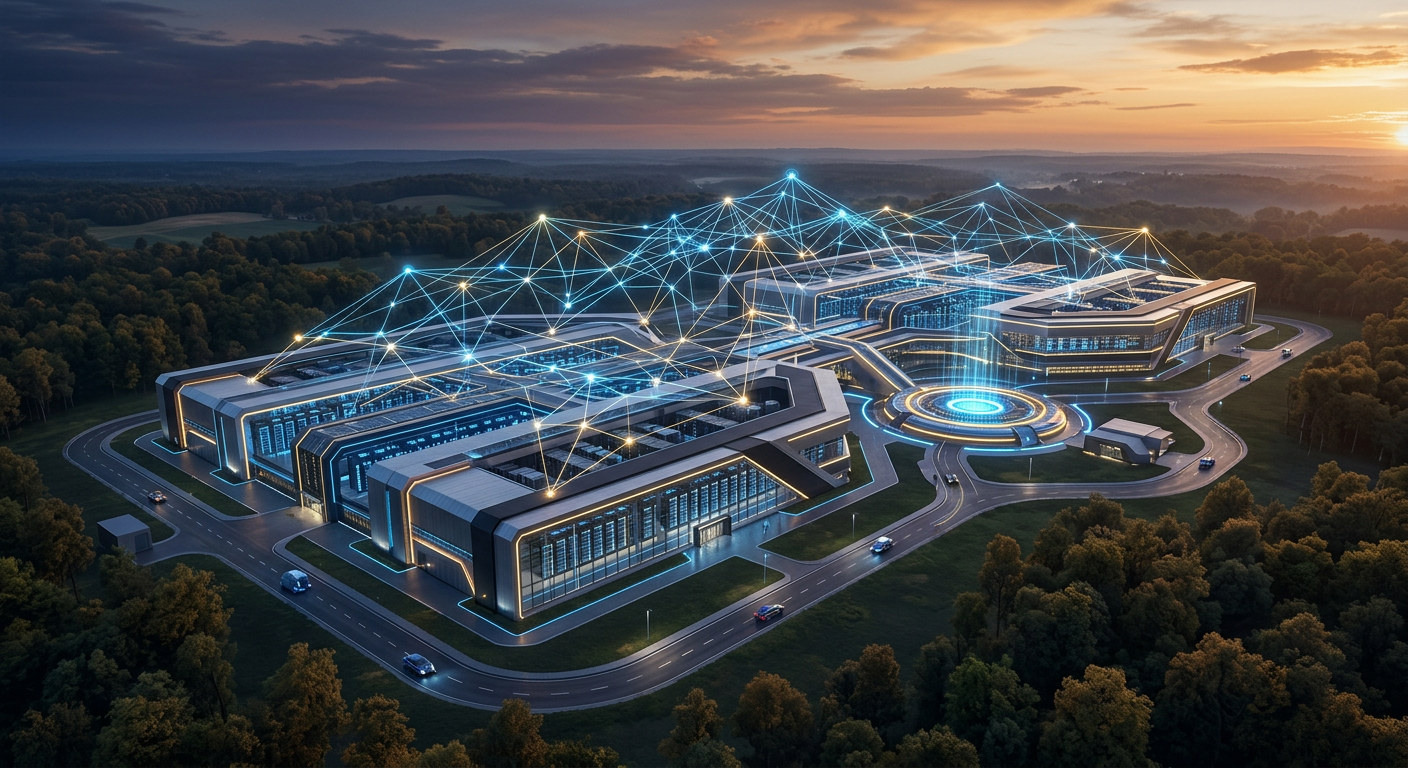
    The planned data center sits on a decommissioned uranium enrichment facility approximately 50 miles south of Columbus, Ohio. SoftBank’s energy subsidiary, SB Energy, is developing the 10-gigawatt campus as part of the broader AI infrastructure buildout that has drawn commitments from the Japanese conglomerate, Oracle, and other major technology investors over the past year.

    According to The Wall Street Journal’s reporting, Nvidia is negotiating to guarantee roughly $250 billion of financing that would cover OpenAI’s data center lease and associated debt. That figure does not include the cost of the Nvidia chips that would fill the facility. On top of the lease guarantee, the company is separately discussing backing up to $350 billion in chip purchases, which would give Nvidia a locked-in customer for its GPU production for years to come.

    The total cost of the Ohio project, once chip procurement is factored in, could exceed $500 billion, making it the largest data center campus ever announced. The full facility, when built to its 10-gigawatt design capacity, would be equivalent in power draw to roughly 10 large nuclear reactors operating simultaneously.

    Bloomberg and other outlets confirmed the WSJ reporting on July 26 and 27, citing sources familiar with the discussions. The talks are described as ongoing and not yet finalized. No binding agreements have been announced.

    Technical Details

    A 10-gigawatt compute campus represents an extraordinary leap in scale compared to existing hyperscale data centers, most of which operate in the range of tens to hundreds of megawatts. The first phase of the Ohio campus is expected to deliver approximately 800 megawatts of capacity by 2028, with subsequent phases scaling the facility toward its full design target over the following years.

    Power is a central challenge for a project of this magnitude. The site’s power supply is controlled by the U.S. government, given its origins as federally managed uranium-enrichment infrastructure. To support the facility’s energy requirements, Japan agreed to invest $33 billion in a natural gas power plant on the federal land as part of its broader commitment to invest in the United States in exchange for reduced tariffs under a recent trade agreement. The energy infrastructure arrangement means the data center’s power supply is effectively tied to a geopolitical and trade framework between Washington and Tokyo.

    Nvidia’s GPU hardware, likely successive generations of its Blackwell and future architectures, would densely populate the campus once chip procurement agreements are finalized. The scale of the facility implies interconnect infrastructure, cooling systems, and networking at levels that would push the boundaries of current engineering practice for concentrated AI compute deployment.

    Industry Impact and Reactions

    The most significant strategic implication of the deal, if it closes, is what it means for OpenAI’s relationship with its existing cloud partners. OpenAI currently relies on Microsoft Azure, Amazon Web Services, and Oracle Cloud for the vast majority of its compute capacity. A self-owned, purpose-built campus of this scale would give OpenAI direct control over its infrastructure economics, reducing its dependence on third-party cloud pricing and capacity constraints. That shift would have material implications for Microsoft in particular, which holds a substantial stake in OpenAI and has been the company’s primary compute provider since 2019.

    For Nvidia, the financing arrangement transforms the company from a chip supplier into something closer to a strategic financial partner. By guaranteeing the data center lease and potentially backing chip purchases, Nvidia is effectively underwriting OpenAI’s infrastructure roadmap in exchange for a guaranteed, long-term customer. Investor commentary noted the circular nature of the arrangement: Nvidia’s own chips are central to the demand that justifies the infrastructure, and Nvidia’s financing would enable the infrastructure that drives chip demand.

    The scale of the Ohio project also reflects the broader industry trend toward hyperscale AI infrastructure commitments. In 2025 and 2026, leading AI companies and their financial backers announced trillions of dollars in aggregate infrastructure spending plans. The Ohio campus, at $500 billion and above, sits at the extreme end of that spectrum and is being closely watched as a signal of how seriously the largest players are treating long-term compute capacity as a competitive moat.

    What Comes Next

    The talks between Nvidia and OpenAI are ongoing, and no formal agreement has been announced. The first concrete milestone to watch is whether a binding financing commitment is reached and publicly disclosed, which would trigger a cascade of regulatory, permitting, and construction planning activity at the Ohio site. The 2028 target for the first 800-megawatt phase gives the project a roughly two-year runway for infrastructure preparation before meaningful compute capacity comes online.

    The broader Stargate initiative, of which this Ohio campus is a centerpiece, has drawn scrutiny from analysts and policymakers regarding the concentration of AI infrastructure, the use of federal land, and the geopolitical entanglements that come with international energy financing. Congressional attention and potential export control considerations related to chip access at a government-adjacent site are factors that could shape the timeline and ultimate structure of any deal.

    Conclusion

    If the reported Nvidia-OpenAI financing agreement closes, it will mark a defining moment in the industrialization of artificial intelligence, one in which the infrastructure underpinning frontier AI systems is measured in hundreds of billions of dollars and involves sovereign governments, chip manufacturers, and energy producers as co-stakeholders. The Ohio campus would give OpenAI the compute independence it has long sought and give Nvidia an anchor customer whose demand could sustain the chipmaker’s production roadmap for the better part of a decade. The talks are still in progress, but the scale of what is being discussed makes this one of the most consequential infrastructure negotiations in the history of the technology industry.

    Stay updated on the latest AI news at Evolve Digital.